I did not set out to memorize a dozen probiotic strain names for fun. It happened because my dentist mentioned, kind of offhand while poking around my gums, that antibacterial mouthwash does not just kill the bad stuff in your mouth -- it takes out a lot of the good bacteria too. That single sentence sent me down a research hole I still have not fully climbed out of eighteen months later.
Here is the problem I kept running into along the way: half the oral probiotic products on my shelf treated their strain list like a garden seed rack -- a wall of Latin names on the label, zero explanation of what any of them were actually studied for. I still remember one lozenge tin that proudly advertised seventeen different strains and could not tell me, anywhere in its marketing copy, what a single one of them was supposed to do for my mouth specifically. That tin is long gone (it did nothing I could measure, for what it is worth), but the annoyance stuck with me. This page is the strain-by-strain cheat sheet I built to fix that for myself -- organized by what each strain is actually researched for, not by how long the ingredient list looks.
Overview of Oral Probiotics
Think of your mouth less like a surface you scrub clean and more like a fish tank or a sourdough starter -- an actual ecosystem, where who gets there first and who is loudest matters more than how hard you scrub. Oral probiotics are specific bacterial strains researchers picked out because they are good at setting up shop on your teeth and gums and crowding out troublemakers like Streptococcus mutans (the cavity crew) and Porphyromonas gingivalis (the gum-disease crew) -- sometimes by literally producing compounds that poison their competition, the same way a sourdough starter's acidity keeps wild yeast from taking over the jar. Gut-health probiotics are not really built for this job; it is a different neighborhood down there. The strains below are the ones that actually have published research behind them, organized by what that research was looking at, not by what sounds impressive on a label.
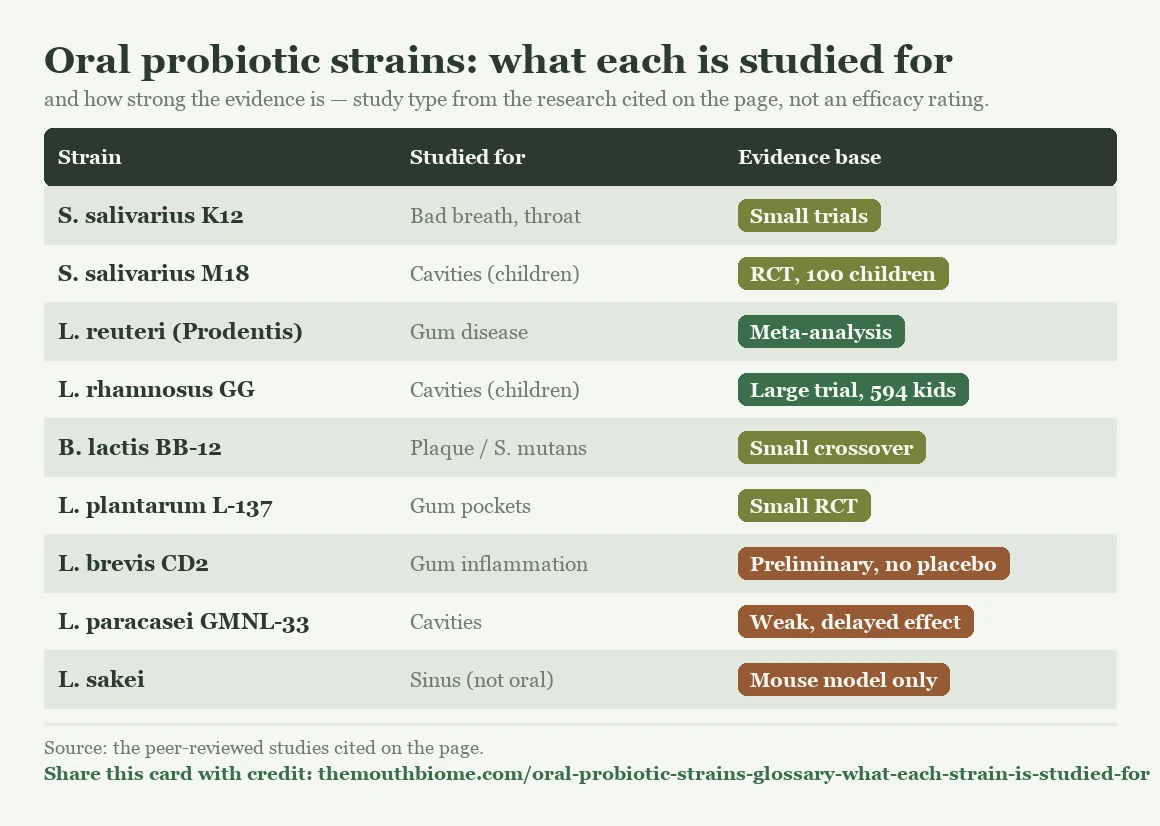
The honest read: only two strains here — L. reuteri (Prodentis) and L. rhamnosus GG — have meta-analytic or large-trial evidence; several rest on a single small or unblinded study, and one (L. sakei) has only been tested in mice.
Glossary of Studied Strains
- Streptococcus salivarius K12 (BLIS K12)
- The strain most oral probiotic products lead with, and for good reason -- it is the most studied one on this whole list. K12 is a natural colonizer that produces its own antimicrobial compounds aimed specifically at Streptococcus pyogenes, the bug behind strep throat and tonsillitis. Researchers have looked at it both for cutting down repeat throat infections and, separately, for bad breath, since some of the same compounds interfere with the sulfur-producing bacteria that make your breath smell like a gym bag (Di Pierro et al., 2013; Burton et al., 2006). Worth knowing: the throat-infection trial was small and unblinded, so I would call that one promising rather than proven -- see the table for the actual numbers.
- Streptococcus salivarius M18 (BLIS M18)
- M18 works a different angle than K12. It produces dextranase and urease -- enzymes that basically dissolve the sticky matrix plaque uses to hang onto your teeth and neutralize the acidic environment cavity-causing bacteria like to work in. It has been studied specifically in kids: one placebo-controlled trial tracked plaque scores directly, and a separate trial measured Cariogram outcomes (the caries-risk calculator dentists use to flag which kids need extra attention) (Burton et al., 2013; Di Pierro et al., 2015).
- Lactobacillus reuteri (DSM 17938 and ATCC PTA 5289)
- This one usually shows up as a pair -- DSM 17938 and ATCC PTA 5289 together, marketed under the name Prodentis -- and it has the best pedigree on this whole list: an actual systematic review and meta-analysis, not just a single small trial. It has been studied specifically as an add-on to a professional deep cleaning (scaling and root planing) for gum disease, where it modestly but measurably improves bleeding on probing and attachment levels (Martin-Cabezas et al., 2016). A separate trial tested that exact two-strain combo on navy sailors stuck at sea with limited access to a toothbrush and dental care, and it held up (Schlagenhauf et al., 2020) -- which, if I am honest, is the kind of real-world stress test I wish more supplement claims got.
- Lactobacillus rhamnosus GG
- Best known outside dentistry as a gut-health strain, but LGG also appears to inhibit Streptococcus mutans, and there is a genuinely large, long-running study behind that specific claim -- hundreds of preschoolers followed for months, not a dozen college students for a weekend. Milk containing LGG measurably lowered caries risk, with the effect strongest in the youngest kids in the study (Näse et al., 2001). This is one of the few entries here I would call reasonably well-established rather than "promising."
- Lactobacillus paracasei GMNL-33
- Honest moment: this one is weaker evidence than the marketing around it implies. GMNL-33 is investigated for sticking well to oral tissue and going after S. mutans, but the actual trial found no difference between the probiotic and placebo groups at any single check-in while people were still taking it -- the S. mutans drop only showed up in the probiotic group two weeks after they stopped (Chuang et al., 2011). That is a real finding, but it is a much more specific and delayed effect than "take it and it kills bacteria," and it is worth knowing before a product's pitch implies otherwise. It is also an adults-only study, not the kids' trial some labels seem to suggest.
- Lactobacillus brevis CD2
- CD2 leans on a compound called arginine deiminase which, skipping the biochemistry lecture, basically starves a pathway that would otherwise fuel inflammation. It has been tested directly on people with chronic gum disease, not oral ulcers despite what some supplement copy implies, and the small trial behind it found real drops in several inflammatory markers in saliva alongside improvement in symptoms (Riccia et al., 2007). No placebo arm in that trial, so file it under promising rather than settled.
- Bifidobacterium animalis subsp. lactis (BB-12)
- BB-12 usually gets delivered in dairy or lozenges, and the research on it is a refreshingly simple story: short-term consumption -- in one trial, ice cream, my favorite kind of clinical trial -- measurably lowered salivary S. mutans counts, though it did not budge lactobacilli levels one way or the other (Caglar et al., 2008).
- Lactobacillus plantarum (specifically L-137)
- This one is delivered heat-killed -- the bacteria are dead, but the leftover cell material still seems to nudge the immune response in the mouth. Tested specifically in people already going through maintenance periodontal therapy (the follow-up cleanings after gum disease treatment), it showed a real edge in pocket-depth reduction at sites that started out deep, on top of standard care (Iwasaki et al., 2016).
- Lactobacillus sakei
- The odd one out on this list. L. sakei is not really an oral-cavity strain at all -- it is a sinus one, and the research behind it is not primarily human. Comparative microbiome sampling flagged it as a species depleted in people with chronic sinus infections, and a mouse-model follow-up showed it could defend against a specific sinus pathogen (Corynebacterium tuberculostearicum) even when the rest of the microbial community was wiped out (Abreu et al., 2012). Interesting mechanism -- but "defended mice" and "will help your sinuses" are two different claims, and nobody has run the human trial yet.
Comparative Research Summary
| Strain Name | Primary Research Area | Observed Mechanism | Key Study Outcome |
|---|---|---|---|
| S. salivarius K12 | Halitosis / Throat Health | BLIS production (bacteriocins targeting S. pyogenes) | 85% of K12-treated subjects (n=23) had a substantial >100 ppb VSC drop at 1 week vs. 30% on placebo (Source). Separately, an unblinded 90-day trial (n=20 treated, 20 untreated) saw about 80% fewer pharyngitis episodes (Source). |
| S. salivarius M18 | Dental Caries | Dextranase & Urease production | Plaque scores significantly lower, P=0.05, in a 100-child RCT (Source). Separate 90-day, high-risk-children trial: improved Cariogram-based caries-risk outcome (Source). |
| L. reuteri (DSM 17938 & ATCC PTA 5289) | Periodontal Disease | Reuterin production / Anti-inflammatory | Meta-analysis: CAL gain -0.42mm (p=0.002), BOP reduction -14.66 (p=0.003); overall PPD reduction only a trend (p=0.06), significant in moderate (-0.18mm, p=0.001) and deep pockets (-0.67mm, p<0.001) (Source). Same two-strain combo: significant improvement, P<0.001, in 72 navy sailors over 42 days (Source). |
| L. rhamnosus GG | Pediatric Caries | Pathogen competition | Caries risk reduced, OR=0.56 (p=0.01), adjusted OR=0.51 (p=0.004), in 594 children over 7 months; clearest at ages 3-4 (Source) |
| L. brevis CD2 | Gingival Inflammation | Arginine deiminase activity | Significant decrease in salivary metalloproteinase, PGE2, IFN-gamma; n=21 chronic periodontitis patients, no placebo arm (Source) |
| B. lactis BB-12 | Plaque Control | Biofilm interference | Significant (p<0.05) drop in salivary S. mutans after 10 days; lactobacilli unchanged; n=24 adult crossover trial (Source) |
| L. paracasei GMNL-33 | Caries Prevention | High oral mucosal adherence | No group difference at any checkpoint during dosing; significant within-group S. mutans drop only 2 weeks after stopping (p=0.016); adults aged 20-26 (Source) |
| L. plantarum L-137 | Periodontal Health | Immune modulation (heat-killed) | Significantly greater pocket-depth reduction (p<0.05) at sites ≥4mm deep at baseline; 19 treated vs. 17 placebo, 12 weeks (Source) |
| L. sakei | Sinus/Upper Respiratory | Competitive exclusion | Defended against C. tuberculostearicum sinus infection in a mouse model, following human microbiome comparison; not yet tested in a human supplementation trial (Source) |
Last verified: 2026-07-11
One more thing before you go strain-shopping: I am not a dentist, a microbiologist, or any kind of health professional -- just someone who fell into a research rabbit hole after five minutes in a dental chair. Everything above is a summary of published research, not medical advice, and oral probiotics are meant to sit alongside dental care, not replace it (yes, still floss). If you are immunocompromised, have a central line or IV catheter, or have a condition your doctor is actively managing, talk to them before starting any probiotic -- Lactobacillus and Bifidobacterium strains are normally harmless, but there are documented case reports of bloodstream infections in people with weakened immune systems or catheters, and that is not a risk worth guessing about on your own.
Sources
- Di Pierro et al. (2013). Clinical evaluation of the oral probiotic Streptococcus salivarius K12 in the prevention of recurrent pharyngitis and/or tonsillitis caused by Streptococcus pyogenes in adults.
- Burton et al. (2006). A preliminary study of the effect of probiotic Streptococcus salivarius K12 on oral malodour parameters.
- Burton et al. (2013). Influence of the probiotic Streptococcus salivarius strain M18 on indices of dental health in children.
- Di Pierro et al. (2015). Cariogram outcome after 90 days of oral treatment with Streptococcus salivarius M18 in children at high risk for dental caries.
- Martin-Cabezas et al. (2016). Clinical efficacy of probiotics as an adjunctive therapy to non-surgical periodontal treatment of chronic periodontitis: a systematic review and meta-analysis.
- Schlagenhauf et al. (2020). Consumption of Lactobacillus reuteri-containing lozenges improves periodontal health in navy sailors at sea.
- Näse et al. (2001). Effect of Long-Term Consumption of a Probiotic Bacterium, Lactobacillus rhamnosus GG, in Milk on Dental Caries and Caries Risk in Children.
- Chuang et al. (2011). Probiotic Lactobacillus paracasei effect on cariogenic bacterial flora.
- Riccia et al. (2007). Anti-inflammatory effects of Lactobacillus brevis (CD2) on periodontal disease.
- Caglar et al. (2008). Short-term effect of ice-cream containing Bifidobacterium lactis Bb-12 on the number of salivary mutans streptococci and lactobacilli.
- Iwasaki et al. (2016). Daily Intake of Heat-killed Lactobacillus plantarum L-137 Decreases the Probing Depth in Patients Undergoing Supportive Periodontal Therapy.
- Abreu et al. (2012). Sinus Microbiome Diversity Depletion and Corynebacterium tuberculostearicum Enrichment Mediates Rhinosinusitis.